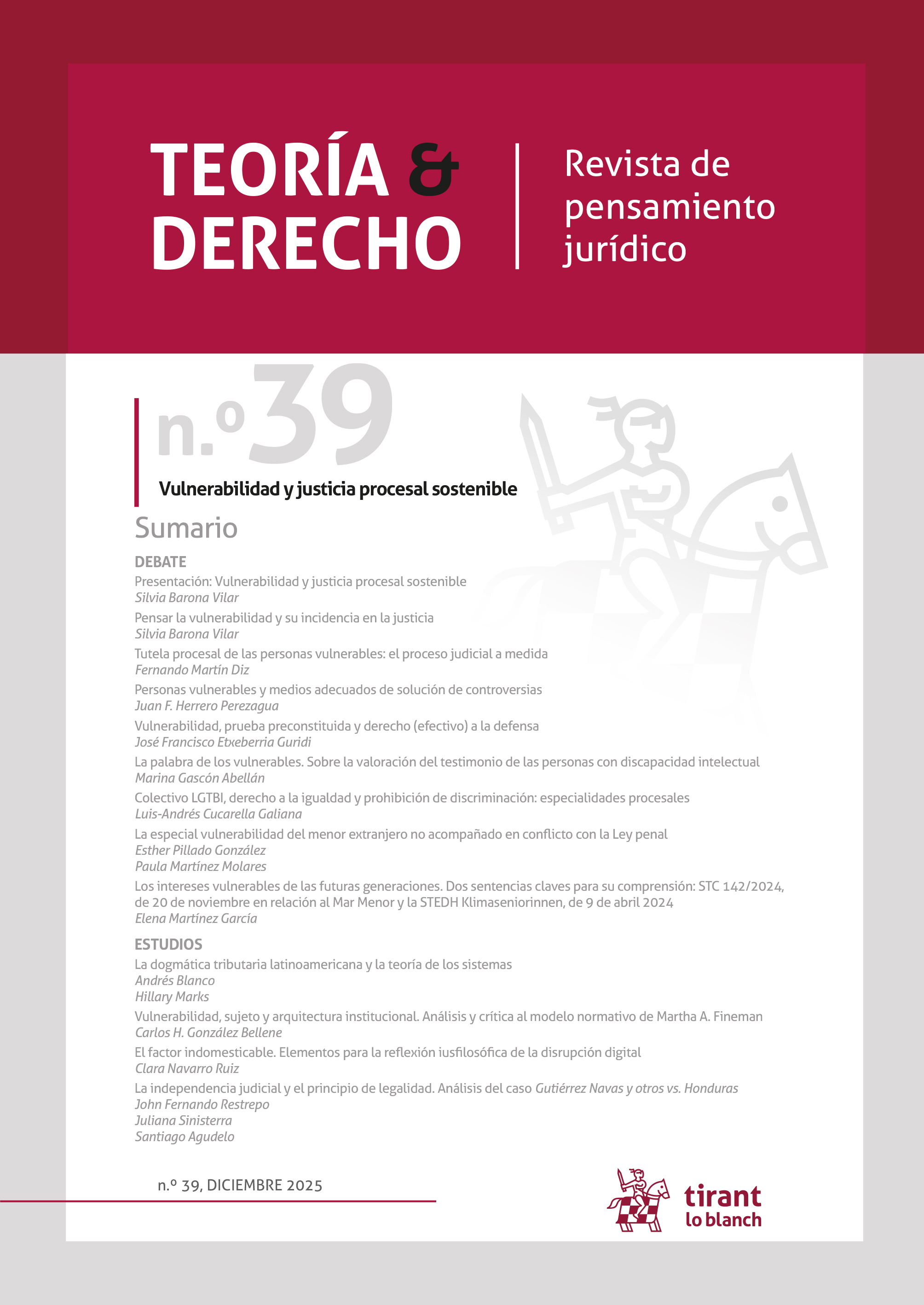
The voice of vulnerable people. On the assessment of testimony from persons with intellectual disabilities
DOI:
https://doi.org/10.36151/TD.2025.134Keywords:
Child’s testimony, psychology of the witness, intellectual disability, evaluation of the witness, credibilityAbstract
Assessing the reliability of a testimony is not a simple matter. The difficulty increases when the witness is a minor, or is under stress, or to influences of any kind, or when his perceptive or intellectual faculties are diminished. In fact, the studies of the psychology of the witness have highlighted this difficulty and have provided very valuable suggestions on how to carry it out in the different cases. One of the especially problematic cases occurs when the declarant is affected by an intellectual disability. In these cases, the evaluation of his testimony is surrounded by myths and false beliefs that either deprive him of credibility without justifying why, or grant him great credibility, but again without justifying why. I address this issue here to: 1) maintain that neither of these two positions is acceptable; and 2) examine what adjustments have to be made to guarantee a quality statement (first) and to correctly assess its reliability (after). Only in this way will your right of access to justice be effective and an epistemically founded decision will be obtained.
Downloads
Downloads
Published
Issue
Section
License
Copyright (c) 2025 Teoría & Derecho. Revista de pensamiento jurídico

This work is licensed under a Creative Commons Attribution-NonCommercial-NoDerivatives 4.0 International License.
 @teoriayderecho